.webp)
Track your order
All Offers
Track your order
All Offers
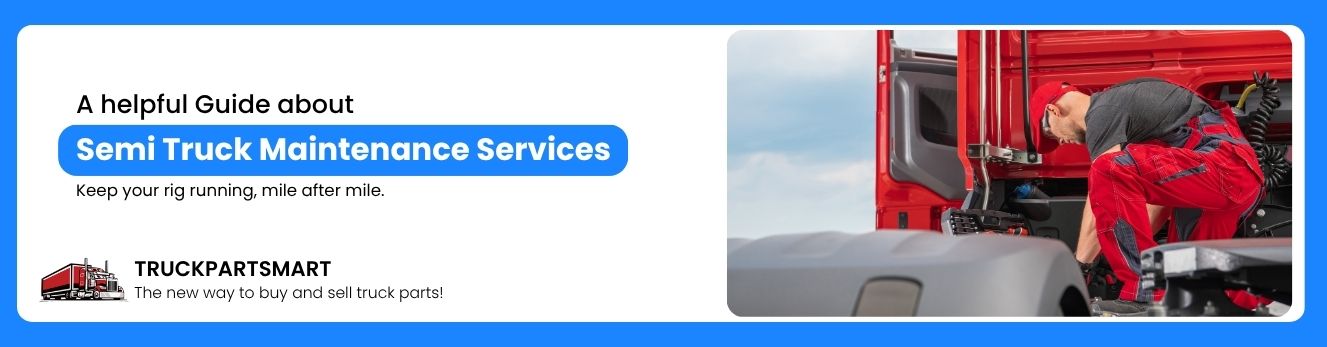
Picture this: it's 2 a.m., your driver is 400 miles from the destination, and the truck has just thrown an engine fault code on a major highway. The load is time-sensitive, the customer is already frustrated, and you're scrambling to find a roadside repair service that won't charge you triple the normal rate. Now imagine that same scenario never happening — because you had a maintenance plan in place.
That's the real difference between reactive and proactive semi truck maintenance services. For fleet managers and owner-operators, this decision doesn't just affect your bottom line. It shapes your reputation, your driver retention, and your ability to compete. This guide breaks down everything you need to know about keeping your trucks road-ready, DOT-compliant, and profitable — from oil changes to predictive diagnostics.
Semi truck maintenance services encompass scheduled inspections, oil changes, brake servicing, tire management, and engine diagnostics. Preventive maintenance costs significantly less than reactive repairs and reduces unplanned downtime, which can run between $448 and $760 per day per truck. A structured maintenance program is essential for fleet profitability and DOT compliance.
When most people hear "truck maintenance," they picture an oil change. The reality is far more comprehensive. Semi truck maintenance services span dozens of interconnected systems — and neglecting even one can cascade into a costly breakdown.
The engine is the core of any semi truck, and its health directly determines your operating costs and lifespan. Engine maintenance includes regular oil and filter changes (typically every 15,000–25,000 miles for modern diesel engines), coolant system flushing, fuel filter replacements, and diesel exhaust fluid (DEF) top-ups for newer emissions-compliant trucks. Skipping oil changes is the single most common cause of premature engine failure. A basic $200 oil change preventing a $15,000 engine rebuild is not an exaggeration — it's a documented outcome that any experienced technician will confirm.
Transmission fluid, differential fluid, and power steering fluid all degrade over time and need systematic attention. Many fleets operating Kenworth T680s, Peterbilt 579s, and Freightliner Cascadias have moved to extended drain intervals using full synthetic lubricants — but that shift requires consistent oil analysis programs to verify the fluid's condition isn't masking hidden wear.
Brakes on a fully loaded semi truck endure stress that passenger vehicle brakes simply aren't designed to handle. Air brake systems require regular inspection of slack adjusters, brake drums, shoes or pads, and the air compressor. DOT regulations mandate a minimum brake lining thickness of 1/4 inch — and enforcement during roadside inspections is strict. Worn brake pads or leaking air systems can lead to failures costing $330–$550 per axle in 2024, and frequent checks save up to 40% by avoiding major repairs (Fleet Advantage, 2024 Maintenance Trends).
Brake servicing should happen at least every 50,000–60,000 miles under normal conditions, and more frequently for trucks hauling heavy loads or operating in mountainous regions.
A semi truck should undergo a basic preventive maintenance check every 10,000–25,000 miles, with daily and weekly inspections to catch early issues. Tires are among the most visible — and most frequently neglected — elements of that checklist. Tire maintenance services include pressure checks, rotation, alignment inspections, tread depth measurement, and blowout damage assessments. Retreaded tires, common across large fleets, need their own inspection protocols.
If you've been operating on a "run it till it breaks" philosophy, the numbers will change your mind fast.
Preventive maintenance expenses are spread out over time, while reactive costs cluster in large, unpredictable sums. Reactive repairs often come with additional hidden costs such as lost revenue from downtime, and over the vehicle's lifespan, preventative care usually results in a lower total cost of ownership.
Think about what actually happens when a truck breaks down unexpectedly. You're paying for the repair itself — yes. But you're also absorbing towing fees, after-hours labor surcharges, expedited parts shipping, driver layover costs, missed delivery penalties, and the long-term damage to your customer relationship. Transmission repairs average around $4,000, while engine overhauls can range from $3,000 to $10,000, and electrical system issues typically cost between $1,000 and $2,500 — all of which hit budgets hardest when they occur unexpectedly.
A single unplanned breakdown on a long-haul route can easily exceed the cost of a full year of preventive maintenance for that truck.
Beyond standard prevention, predictive maintenance takes the approach a step further. Using data analytics and real-time monitoring, predictive maintenance allows companies to predict and address component failures before they occur, reducing downtime and avoiding expensive repairs. Platforms like Fleetio, Geotab, and Samsara integrate directly with truck telematics to flag anomalies in engine performance, brake pressure, and tire temperature — giving maintenance teams days or weeks of advance warning instead of a roadside crisis.
Fleet operators using Fleetio have reported scheduling maintenance around active loads with minimal service interruption, effectively turning a reactive operation into a precision-timed machine.
Your maintenance schedule isn't just a business decision — it's a legal requirement. The Federal Motor Carrier Safety Administration (FMCSA) mandates systematic inspection, repair, and maintenance of all commercial motor vehicles. Failing a DOT roadside inspection doesn't just cost you a fine; it puts your truck out of service immediately, and out-of-service violations appear on your safety score, affecting your Compliance, Safety, Accountability (CSA) rating.
Level I DOT inspections — the most thorough — cover driver documentation and vehicle condition together. Inspectors look at brakes, tires, lights, coupling devices, fuel systems, steering, suspension, and frame condition. The most common violations leading to out-of-service orders are brake system defects, tire defects, and lighting failures. All three are entirely preventable with a structured maintenance schedule.
Annual vehicle inspections, required by FMCSA regulations, must be performed by a qualified inspector and documented with a vehicle inspection report retained for 14 months. Third-party inspection services like those offered by Ryder, Love's Truck Care, and TA Truck Service simplify this process for fleets without in-house maintenance facilities.
Even experienced fleet operators fall into patterns that silently inflate their costs. Here are the most frequent mistakes — and how to correct them.
Many owner-operators change oil on a mileage schedule without ever testing whether the oil actually needs changing — or whether it's masking internal engine wear.
Implement a quarterly oil analysis program through labs like Blackstone Laboratories. A $35 sample can reveal coolant contamination, metal wear particles, and oxidation long before they become catastrophic.
On emissions-equipped trucks (2007 and newer), the DPF collects soot from the exhaust stream. When it gets clogged, fuel economy drops, engine stress increases, and regeneration cycles become longer. Fleets running Volvo VNLs and Mack Anthem models frequently report DPF neglect as a leading cause of engine derating.
Follow manufacturer-recommended DPF cleaning intervals and use low-ash engine oil.
A leaking air line fitting, a cracked mudflap bracket, or a minor wheel seal weep all look minor in isolation. Left alone, they compound.
Create a rolling defect log that drivers complete after each trip and review it during every PM service.
Budget parts from unknown suppliers might save $50 upfront but rarely hold up to the load cycles of commercial trucking.
Source OEM-equivalent or branded parts from suppliers like FleetPride, TruckPro, or PACCAR Parts, which maintain commercial accounts with delivery guarantees.
Regulations require drivers to conduct pre-trip and post-trip inspections — but in practice, these are often rushed or skipped entirely.
Use a digital DVIR (Driver Vehicle Inspection Report) app that integrates with your fleet management system, creating a timestamped inspection trail and flagging uncompleted items before dispatch.
Overheating is one of the leading causes of engine damage in semi trucks, yet cooling system flushes and hose inspections are routinely pushed back.
Include coolant condition testing and hose integrity checks in every major service interval.
Amazon Freight integrated Geotab telematics across a significant portion of its North American fleet, enabling real-time monitoring of brake wear, tire pressure, and engine fault codes. By shifting from time-based to condition-based maintenance, the operation reduced unplanned breakdowns substantially and improved vehicle uptime across long-haul corridors. The key outcome was not just fewer breakdowns — it was the ability to schedule service around load cycles rather than disrupting active deliveries.
Werner Enterprises, one of the largest U.S. truckload carriers, has long operated its own internal maintenance facilities staffed with certified diesel technicians. By keeping PM in-house and enforcing strict interval compliance, Werner has sustained average fleet ages below the industry norm. The average truck age in the broader industry dropped to 3.8 years in 2023, and carriers with disciplined trade cycles and maintenance programs are among the most competitive in the market (2024, ATRI). Werner's model illustrates that maintenance infrastructure is itself a competitive asset.
A small fleet owner running three Kenworth T680 trucks in the Southeast reported spending over $18,000 in a single year on DPF replacements and emergency engine derating events. After partnering with a regional Kenworth dealer for a structured quarterly PM program — including DPF cleaning every 200,000 miles and low-ash oil changes — the fleet went 18 months without a single emissions-related breakdown, cutting related costs by roughly 70%.
For businesses operating trucks across multiple states without centralized maintenance hubs, Ryder's mobile maintenance service has become a practical solution. Ryder offers in-shop, on-site, and mobile maintenance, allowing businesses to choose the most convenient service location and minimizing disruption to operations. A national food distribution company using Ryder's managed maintenance program reduced its average truck downtime by scheduling mobile service calls at distribution centers during off-peak loading hours — a direct operational efficiency gain without a single truck leaving a route.
This article draws on data from the American Transportation Research Institute (ATRI), the Federal Motor Carrier Safety Administration (FMCSA), FleetMaintenance, FinditParts, and Decisiv's Q3 2024 Service Trends Report.
Industry databases including Geotab's trucking statistics portal, FinditParts market data, and Decisiv's SRM platform analytics.
Semi truck maintenance services aren't a line item to minimize. They're the infrastructure that keeps your revenue moving. Every oil change, brake inspection, and tire rotation is an investment in uptime, safety, and profitability. The fleets winning in today's competitive freight environment aren't the ones cutting maintenance corners — they're the ones treating their trucks with the same strategic discipline they apply to routes, rates, and driver management.
Start by auditing your current maintenance schedule against your actual breakdown history. If you're seeing more than two unplanned roadside events per truck per year, your PM program has gaps. Partner with a certified service provider, implement a digital inspection workflow, and set a realistic per-mile maintenance fund. Your future self — and your drivers — will thank you.
Ready to cut your fleet's downtime and repair costs? Download a free semi truck maintenance checklist from TRUCKPARTSMART and build your preventive program today.
Semi truck maintenance services typically include oil and filter changes, brake inspections and adjustments, tire pressure checks and rotations, DOT annual inspections, DPF cleaning, cooling system flushes, transmission servicing, and electrical system diagnostics. The exact scope depends on truck age, mileage, and operating conditions.
Most manufacturers recommend a basic PM service every 15,000–25,000 miles for engine oil and filters. Tires and brakes should be inspected every 10,000–15,000 miles. Annual DOT inspections are federally required. High-mileage operations may require more frequent intervals.
The median maintenance cost for fleets is approximately $21,242 per truck per year, though owner-operators running older or high-mileage trucks can spend significantly more. Budget estimates range from $15,000 to $25,000 annually for trucks covering 100,000–120,000 miles.
Adopt a preventive maintenance schedule, use telematics to catch faults early, source quality replacement parts, train drivers on proper pre-trip inspections, and build a dedicated maintenance fund of 10–15 cents per mile. Predictive maintenance tools from platforms like Fleetio and Samsara offer strong ROI for fleets of any size.
A truck can be placed out-of-service immediately, meaning it cannot legally operate until the violation is corrected and cleared. Recurring violations affect the carrier's CSA score, which can trigger audits, impact insurance rates, and restrict freight contract eligibility.
Large fleets with volume and staffing may benefit from in-house facilities. Smaller fleets and owner-operators typically get better value from third-party providers like Ryder, Love's Truck Care, TA Truck Service, or authorized dealer networks that offer warranty-compatible service and certified technicians.
Get daily news on upcoming offers from many sellers all over the world.
Download the app today and be part of the new TRUCKPARTSMART marketplace! It's the only marketplace app strictly for truck parts and truck-related services.




© TRUCKPARTSMART current_year. All rights reserved.