.webp)
Track your order
All Offers
Track your order
All Offers
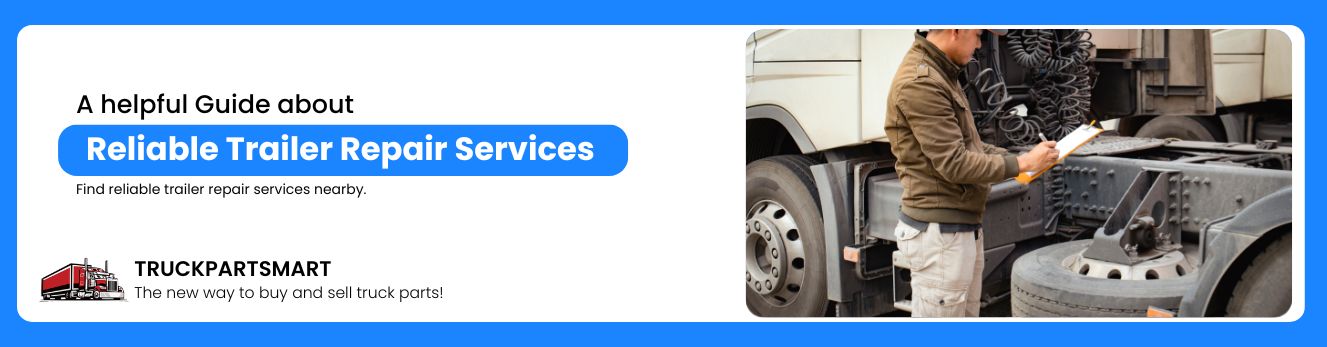
A trailer that cannot roll is freight that cannot move. Whether you run a 53-foot dry van on an interstate corridor, a flatbed hauling construction equipment through the Midwest, a refrigerated trailer delivering temperature-sensitive loads across state lines, or a specialized heavy haul configuration on permitted routes, trailer downtime has a direct and immediate cost to your operation.
Finding reliable trailer repair near you — quickly, when you need it, without getting overcharged or waiting days for a shop that is not equipped for your trailer type — is one of the practical operational challenges that owner-operators and fleet managers face consistently throughout a career in trucking.
This guide covers everything you need to know about trailer repair in 2026 — what trailer repair services cover, how to find qualified providers near you, what major repairs cost, how to evaluate a trailer repair shop, what to do during a roadside trailer emergency, and how to build the preventive maintenance program that keeps trailer repairs planned rather than reactive.
Trailer repair is not a single service category. It spans structural, mechanical, electrical, refrigeration, and specialty repair disciplines that require different equipment, different expertise, and different shop configurations. Understanding the full scope helps you identify the right provider for your specific repair need.
Structural trailer repair covers damage to the trailer frame, crossmembers, floor, walls, roof, nose, and rear doors. Collision damage, loading dock impacts, road debris strikes, and the cumulative fatigue of millions of loaded miles all create structural repair needs on commercial trailers.
Quality structural trailer repair requires certified welding capability for frame and crossmember work, knowledge of trailer manufacturer specifications for structural component replacement, and in many cases DOT inspection certification to return the trailer to service after structural repairs that affect roadworthiness.
Trailer axles, suspension systems, and wheel ends are among the highest-frequency repair categories across all trailer types. Air ride suspension components — air bags, height control valves, shock absorbers — wear steadily under load. Leaf spring suspensions crack, sag, and lose load rating over high mileage. Wheel bearings fail. Hub seals leak. Brake drum wear accelerates under aggressive brake use.
Trailer axle and suspension repair requires knowledge of the specific suspension systems used on your trailer — Hendrickson, Holland, SAF-Holland, and Reyco are the major suspension manufacturers — and the specific axle manufacturer's service requirements for your axle configuration.
Trailer brake service covers air brake chamber replacement, slack adjuster adjustment and replacement, brake lining replacement, drum and rotor service, ABS sensor replacement and calibration, and glad hand and air line service. Brake system work on trailers is safety-critical and subject to FMCSA regulations governing both the work performed and the technicians performing it.
A trailer with brake defects is an out-of-service candidate at any DOT inspection. Brake maintenance on trailers deserves the same quality attention as brake maintenance on the tractor.
Trailer electrical systems — running lights, brake lights, turn signals, ABS, and on refrigerated units the full electrical load of the reefer unit — develop faults from connector corrosion, wiring chafe, moisture intrusion, and the vibration of millions of road miles. Electrical faults are among the most common causes of trailer out-of-service violations at DOT inspections.
Trailer electrical diagnosis requires systematic circuit testing rather than component replacement guessing. A shop that replaces a light board, then a socket, then a wiring harness segment to find an intermittent ground fault is billing you for its diagnostic shortcomings. A shop with systematic electrical diagnostic capability finds the fault efficiently.
Landing gear failures — bent legs, broken gear boxes, stripped crank mechanisms — leave trailers unable to be safely dropped and picked up. Landing gear service ranges from lubrication and adjustment to full leg and gearbox replacement. This is a high-frequency repair category because landing gear takes abuse at every drop and hook event.
The connection between tractor and trailer — the fifth wheel on the tractor and the kingpin on the trailer — requires regular inspection and service to maintain safe coupling and prevent the play that develops from wear and that affects handling stability at highway speeds. Kingpin wear measurement and replacement is a trailer repair discipline that requires specific tooling and knowledge of the manufacturer's wear limits for the specific kingpin configuration.
For refrigerated trailer operators, the reefer unit is the most complex and most service-intensive component on the trailer. Thermo King and Carrier Transicold are the dominant reefer unit manufacturers in North America, and their units require brand-specific diagnostic software, certified technicians, and manufacturer-specified parts for warranty-compliant service.
Reefer repair is a specialized sub-category within trailer repair. Not every trailer repair shop has reefer capability. When sourcing trailer repair for a reefer unit, verify specifically that the shop has the diagnostic equipment and certified technicians for your specific reefer brand and model.
Every commercial trailer operating on US highways requires an annual DOT inspection performed by a certified inspector. The inspection covers brakes, lights, tires, wheels, steering, suspension, frame, and coupling devices against FMCSA standards. Shops performing DOT inspections must have certified inspectors and follow the inspection procedures specified in 49 CFR Part 396.
Annual inspections are an opportunity for systematic trailer assessment beyond the specific items the inspection covers — a quality shop performing a DOT inspection should flag developing issues that the regulatory checklist does not specifically require but that affect the trailer's service reliability.
When searching for trailer repair near your location, specificity in your search terms produces better results than generic queries.
Search for "trailer repair" plus your specific trailer type — "dry van trailer repair," "flatbed trailer repair," "reefer trailer repair" — rather than just "trailer repair." This filters results toward shops with the specific capability your trailer requires rather than shops that repair any trailer type at a general level.
Add your location specifically — city name, highway corridor, or nearest town if you are in a rural area. "Semi trailer repair Milwaukee" or "trailer axle repair I-94 corridor" produces more relevant results than a location-agnostic search.
For reefer unit service specifically, search for your reefer brand by name — "Thermo King service near me" or "Carrier Transicold repair" — to find brand-authorized service centers rather than general trailer shops that may not have the specific diagnostic capability your reefer unit requires.
The major truck stop chains — Loves, Pilot Flying J, and TA/Petro — operate trailer maintenance and repair services at many of their locations along major freight corridors. Their capabilities vary significantly by location but they provide a known minimum baseline of trailer repair access at points that are already integrated into most drivers' routes.
For urgent trailer repairs on a corridor — a blown tire, a lighting fault before an inspection, a landing gear problem — truck stop service centers provide accessible 24-hour capability that may not match a specialty shop's depth but that can address the immediate need and return the trailer to service.
Major trailer manufacturers — Wabash National, Great Dane, Utility, Hyundai Translead, Strick — have authorized dealer and service networks that provide factory-trained repair capability for their specific trailer designs. For trailers still under manufacturer warranty, authorized service is required to maintain warranty validity.
Manufacturer dealer networks are most valuable for structural repairs and component replacements on newer trailers where factory specifications and warranty compliance matter. Their coverage is concentrated at major freight hubs and is thinner in secondary and rural markets.
Quality independent trailer repair shops are often the best option for out-of-warranty trailers — offering deeper technical capability, faster turnaround, and more competitive pricing than dealer networks or truck stop service centers for most repair categories.
The challenge with independent shops is quality variation. Evaluating an independent shop before committing a major repair requires the same due diligence criteria described later in this guide.
Mobile trailer repair services — technicians who come to the trailer rather than requiring the trailer to come to a shop — have expanded significantly in 2026. For roadside repairs, for trailers at facilities where moving them is impractical, and for after-hours urgent repairs, mobile trailer repair provides access to qualified technicians without tow cost.
Mobile capability covers most electrical repairs, brake adjustments and chamber replacements, tire service, landing gear repairs, and lighting work. Major structural repairs, axle replacements, and reefer overhauls require shop-based service.
Dry van repair, flatbed repair, reefer repair, tanker repair, and heavy haul trailer repair are different enough in their requirements that shops that specialize in specific trailer types typically deliver better quality and faster turnaround than generalist shops.
Ask specifically about the shop's experience with your trailer make and type. A shop that primarily services dry vans may not be the right choice for a flatbed with specialized tie-down and decking requirements. A shop with certified reefer technicians for Thermo King units may not have equal capability for Carrier Transicold.
Any shop performing DOT annual inspections must have certified inspectors and comply with FMCSA inspection requirements. This certification is verifiable and is a baseline quality indicator for trailer repair capability — shops that invest in DOT inspection certification are demonstrating a commitment to regulatory compliance that extends to their repair work.
For structural repairs — frame work, crossmember replacement, floor repair — certified welding capability matters. AWS D1.1 structural welding certification and trailer manufacturer-specific structural repair certifications indicate that the shop's welding work meets documented quality standards. Uncertified structural welds on a commercial trailer frame are a safety issue that can have consequences well beyond the repair cost.
Ask what parts brands the shop uses for trailer repairs. For suspension components, brake parts, and wheel end components, established manufacturer brands — Hendrickson, SAF-Holland, Meritor, Bendix — indicate a parts quality commitment. Shops that use whatever is cheapest and most available without a stated parts quality policy create reliability risk in their repairs.
Trailer downtime has real operational cost. A shop that cannot provide a realistic and committed turnaround estimate before beginning work is a shop that may hold your trailer for days or weeks longer than the actual repair requires. Get a written turnaround commitment before authorizing significant work.
A reputable trailer repair shop provides a written estimate before work begins, requires your authorization before exceeding the estimate, and provides a written warranty on parts and labor — typically 12 months or 100,000 miles for quality shops.
Understanding realistic repair costs prevents overpayment and helps you evaluate quotes accurately.
Structural RepairsAxle, Suspension, and Wheel EndBrake SystemElectricalLanding Gear and CouplingRefrigeration Unit ServiceDOT Annual InspectionTrailer Repair Cost and Service Comparison TableA trailer problem that develops on the road requires immediate and systematic response. How you handle the first ten minutes determines how quickly the situation resolves and how safe the situation remains while it does.
If a trailer problem develops while moving — a tire blowout, a sudden drag, a loud structural noise — get off the travel lane as safely and quickly as possible. Activate hazard lights immediately. Deploy emergency triangles or road flares at the FMCSA-required distances behind the trailer — 10 feet, 100 feet, and 200 feet on a two-lane road, 10 feet and 100 and 200 feet behind in the direction of oncoming traffic on a divided highway.
Stay in the cab or beyond the guardrail. Do not stand between your trailer and passing traffic while assessing the situation.
Take two minutes to assess what happened before calling anyone. Walk the trailer perimeter. What is the visible problem? Is it a blown tire? A dragging brake chamber? A broken air line? A structural failure? A landing gear that has dropped? Visible fluid or debris under the trailer?
A specific description of the problem when you call for service accelerates dispatch, ensures the responding technician brings appropriate equipment and parts, and reduces the diagnostic time once they arrive.
If you have a commercial roadside assistance plan — and trailer coverage should be explicitly included in your plan, not assumed — call their 24-hour dispatch line with your location, a description of the problem, and your trailer type and configuration. They dispatch the nearest qualified service provider with your specific repair need.
Early notification gives your dispatcher maximum time to arrange alternatives — a load swap, a drop-and-hook arrangement, customer communication about delivery timing — before the situation becomes a crisis. A dispatcher informed at the first minute of a breakdown has more options than one informed two hours later.
Photograph the problem before anyone touches the trailer. Photograph the surroundings — road conditions, mile marker, any contributing factors visible in the environment. This documentation protects you in insurance claims, supports warranty claims on recently repaired components, and provides the evidence base if the roadside situation involves another party.
The most affordable trailer repair is the one you prevent through consistent preventive maintenance. Trailer PM is less structured than tractor PM in most owner-operator operations — and that gap between tractor maintenance discipline and trailer maintenance discipline is where most unexpected trailer repair costs originate.
Every pre-trip inspection should cover trailer lights — all running, brake, and turn signal positions — tire condition and inflation across all trailer axles, brake system function including a full brake application check, landing gear condition and operation, rear door seals and latches, coupling security, and glad hand connections and air line condition.
The pre-trip inspection is not paperwork compliance. It is the systematic check that catches developing problems — a tire losing pressure slowly, a brake light socket corroding, a glad hand seal beginning to leak — before they become roadside failures or DOT violation citations.
The annual DOT inspection is a regulatory requirement. Treating it as the entirety of your trailer maintenance program is not enough. Use the annual inspection as the trigger for a more comprehensive assessment that covers items the regulatory checklist does not specifically require — suspension component wear assessment, structural inspection for fatigue cracks, electrical system testing beyond the specific light checks the inspection requires, and coupling component wear measurement.
A quality trailer repair shop performing a DOT inspection proactively flags these additional items. This is what separates a quality inspection relationship from a bare-minimum compliance exercise.
Trailers operating in northern climates require specific winter preparation — brake system air dryer service to prevent moisture accumulation that freezes in air lines, suspension component lubrication with cold-temperature greases, and lighting system inspection before reduced visibility winter conditions elevate the enforcement priority of lighting violations.
Spring inspection after a northern winter should assess structural components for fatigue cracks that cold-temperature operation and road salt exposure accelerate, suspension components for corrosion damage, and floor condition on dry van trailers where moisture accumulation during winter operation creates rot and delamination.
Trailer repair cost has two components — labor and parts. The parts component on major trailer repairs is substantial and represents a real savings opportunity when sourced through competitive channels rather than accepting whatever the repair shop supplies at their markup.
Quality aftermarket suspension components from established manufacturers — Hendrickson, SAF-Holland, Reyco — match OEM specifications and are appropriate for out-of-warranty trailer repairs. For axle replacements, used OEM axles from reputable dismantlers with documented mileage provide genuine quality at 40 to 60 percent below new axle pricing.
FMCSA-certified brake components from Bendix, Haldex, and Meritor are the appropriate quality standard for trailer brake repairs. These components are certified to federal safety standards and are widely used in fleet maintenance programs across the industry.
Trailer floor boards, wall panels, roof panels, and rear door components from quality aftermarket suppliers fit major trailer brands accurately at 30 to 50 percent below manufacturer dealer pricing. For trailers still under structural warranty, OEM parts from authorized dealers maintain warranty validity.
Landing gear components from SAF-Holland and Jost — the dominant landing gear manufacturers — are available through quality aftermarket channels at competitive pricing. Kingpin replacement components should always be OEM or OEM-equivalent given the safety criticality of the fifth wheel connection.
TruckPartSmart carries verified trailer parts from established manufacturers across all major trailer types — suspension components, brake parts, electrical components, structural panels, landing gear, and coupling hardware — from verified sellers across the USA. For owner-operators and fleet managers sourcing parts for trailer repairs, the platform provides competitive pricing across multiple sellers and access to used OEM inventory that local suppliers cannot match.
Trailer repair is not an optional maintenance category. Trailers accumulate wear from millions of loaded miles, road impacts, dock strikes, seasonal temperature extremes, and the constant vibration of highway operation. Every trailer in active service will need regular maintenance and periodic significant repair — the question is whether those repairs happen on your schedule or the road's schedule.
The operators who manage trailer maintenance and repair costs most effectively in 2026 are those who have established shop relationships before emergencies force the issue, who understand what trailer repairs cost and can evaluate quotes intelligently, who use competitive parts sourcing to reduce total repair cost on major work, and who maintain the pre-trip inspection discipline that catches developing problems before they become roadside failures.
Finding reliable trailer repair near you — quickly, when you need it, from a shop with the right capability for your trailer type — starts with knowing what to look for and having the evaluation criteria to recognize it when you see it.
Your trailer keeps the freight moving. Keep it road-ready.
Need trailer parts for your next repair? Browse TruckPartSmart for verified OEM, used OEM, remanufactured, and quality aftermarket trailer parts — suspension components, brake parts, axles, electrical components, structural panels, and more — from verified sellers across the USA for all major trailer brands and configurations.
Search Google Maps for "trailer repair near me" or "mobile trailer repair" plus your specific location. Call your commercial roadside assistance provider's 24-hour dispatch line — trailer coverage should be explicitly included in your plan. The nearest major truck stop chain — Loves, Pilot Flying J, TA — can often perform urgent repairs or refer you to local trailer repair capability. State police dispatchers also have relationships with local heavy-duty service providers and can provide referrals.
Minor repairs — brake chamber replacement, electrical diagnosis and repair, tire service, landing gear adjustment — are typically completed same-day or next-day at a quality shop. Major structural repairs, axle replacements, and reefer overhauls take 3 to 7 business days depending on parts availability and shop workload. Getting a written turnaround commitment before authorizing work protects against delays that extend beyond reasonable repair time.
Many heavy-duty truck repair shops also service trailers, but trailer repair depth varies. A shop with strong diesel engine capability may have limited trailer structural repair or reefer service capability. Evaluate trailer repair capability specifically rather than assuming it matches the shop's tractor service quality. For reefer units, brand-certified service is important enough to use a separate specialist shop if your primary shop does not have that certification.
Brake system defects — out-of-adjustment brakes, worn linings, defective chambers — are consistently the leading cause of trailer out-of-service violations at DOT inspections and roadside checks. Lighting violations are the second most common category. Both are preventable through disciplined pre-trip inspection and consistent PM. An out-of-service violation means the trailer cannot move until the defect is corrected — the downtime cost of a preventable violation always exceeds the cost of the maintenance that would have prevented it.
Federal regulations require annual DOT inspection. Best practice for commercial trailers in active service is a comprehensive inspection at every 90 days or 50,000 miles — whichever comes first — that covers all safety-critical systems plus the structural and electrical condition items that the annual DOT inspection alone may not catch. High-mileage trailers in demanding applications benefit from more frequent brake and wheel end inspections.
The economics depend on the trailer's overall condition, the cost of the specific repair, and the trailer's current market value. A repair that exceeds 30 to 40 percent of the trailer's current market value on a unit with multiple other systems approaching end of life deserves a replacement evaluation rather than automatic approval. Major structural repairs on trailers over 15 years old require particularly careful cost-benefit assessment given the ongoing maintenance demands of aging trailer equipment.
Get daily news on upcoming offers from many sellers all over the world.
Download the app today and be part of the new TRUCKPARTSMART marketplace! It's the only marketplace app strictly for truck parts and truck-related services.




© TRUCKPARTSMART current_year. All rights reserved.